
How future narratives shape the present
A keynote transcript from the Legal Foresight Workshop

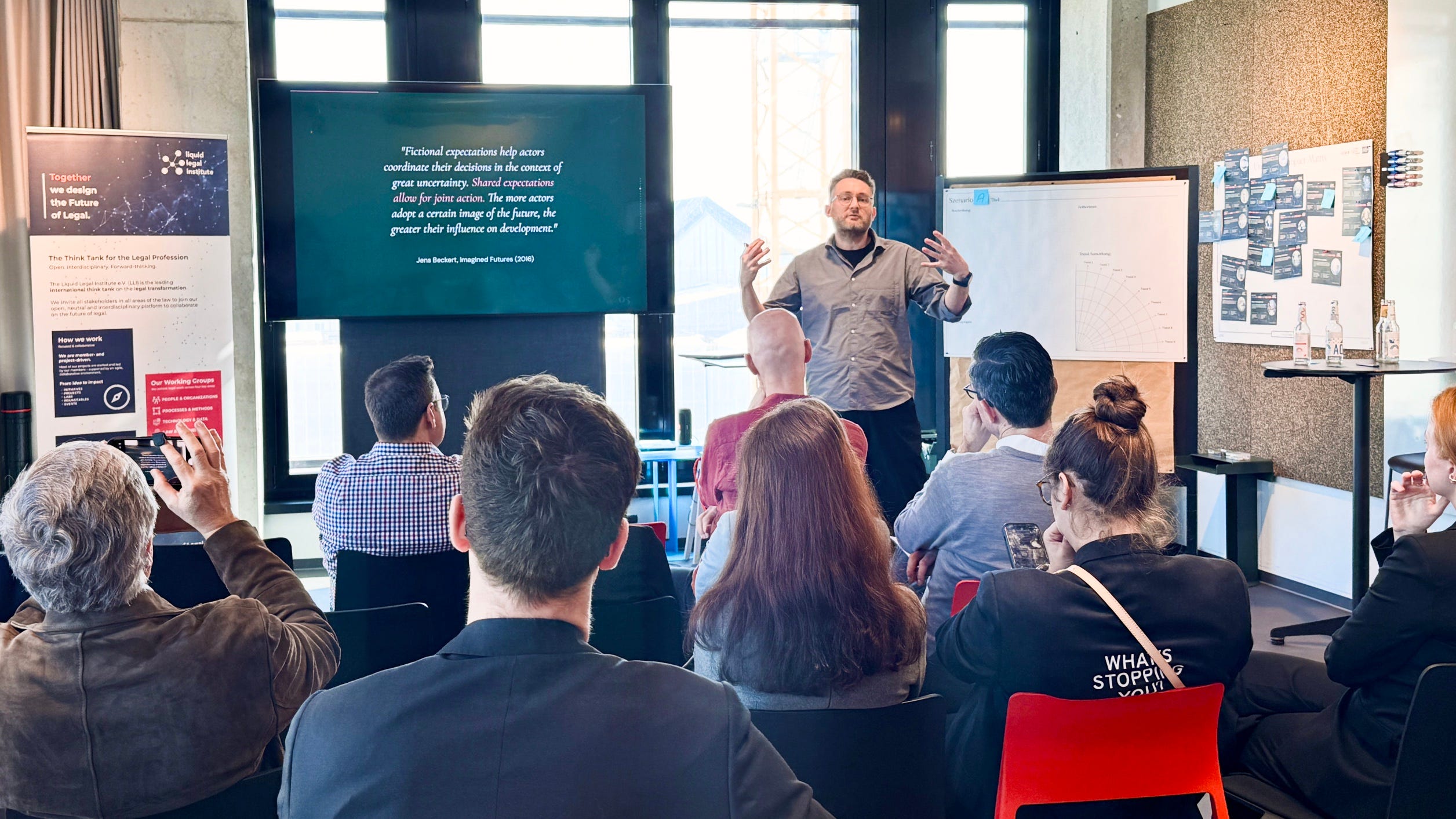
The Liquid Legal Institute brings together over 1,500 legal professionals and organizations working on the transformation of the legal industry. Their Legal Foresight Office runs a workshop series exploring what the future of law looks like. In the first workshop in November 2025, participants developed four scenarios along two axes: weak vs. strong rule of law and incremental vs. disruptive digital transformation. For the second workshop on 5 March 2026 in Munich, I was invited to kickstart the afternoon with a keynote.
This text is a cleaned-up transcript of my keynote.
I like a challenge. The post-lunch speaking slot is the peak challenge of public speaking. The tortellini are getting heavier, the attention is lighter. Club-Mate, cola, coffee: whatever you need. We will get through this.
You spent the last session before lunch looking at trends and placing them on an uncertainty-impact matrix. For each one, you had to decide: how certain or uncertain is this? How high or low is the impact if it actually plays out? You discussed, you argued, and some of you couldn’t agree. But here’s my question: how did you make those calls? What were you basing them on? We usually don't ask. And when you look closely, the answer is almost never data. So how do we actually make these decisions?
Three forces that shape every decision
There is a model I constantly come back to in my work, the Futures Triangle. It shows, in a very simple way, what influences the decisions we make every day.
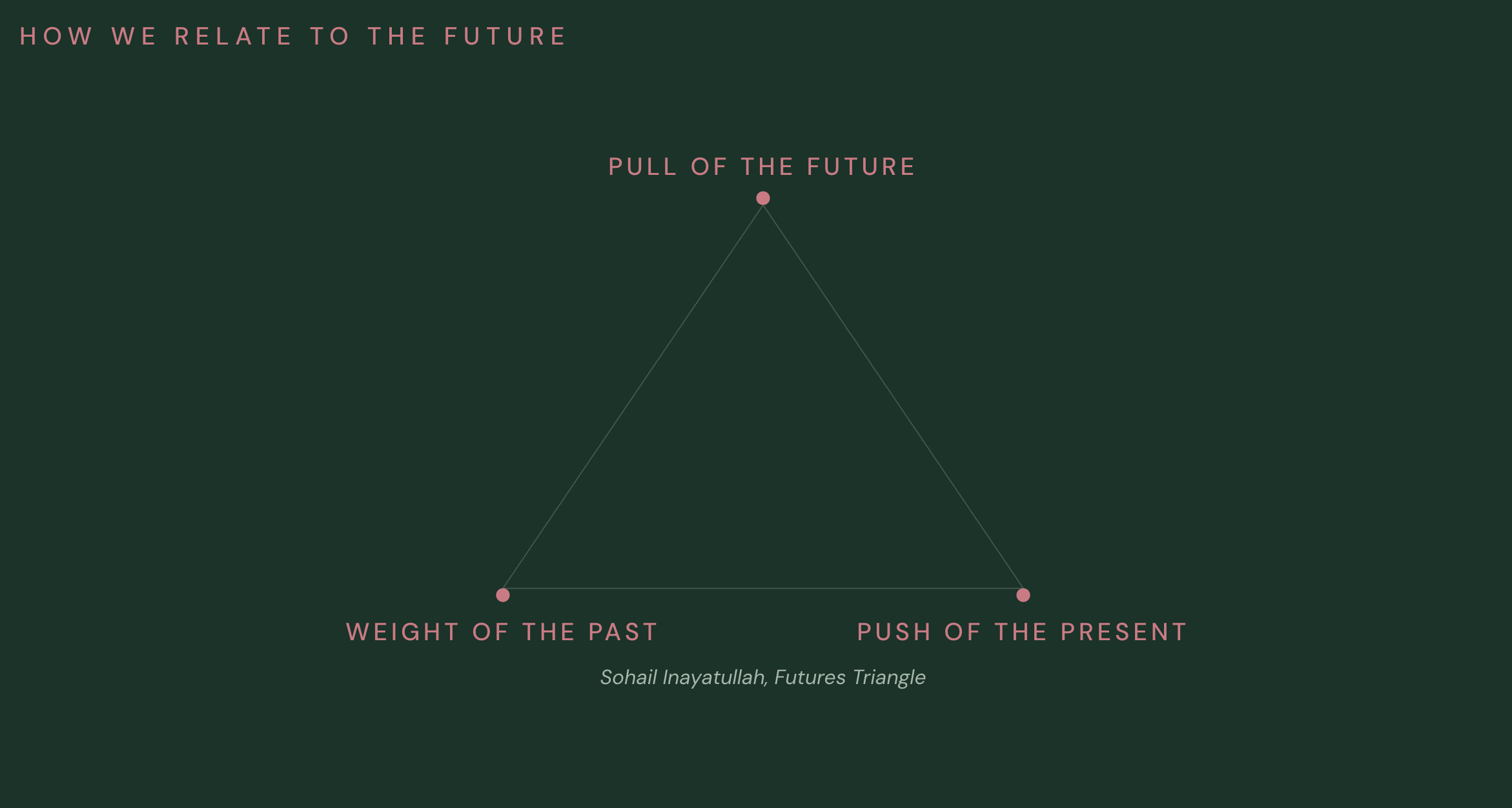
First, the weight of the past. You can sum it up in a single sentence: “We have always done it this way.” Path dependencies, rituals, traditions, regulation, law. That is how things were done, and it pulls our decisions in a certain direction.
Then there is the push of the present. All the topics crashing into us right now. The emails piling up. Which fire do I put out first? The question everyone has to take a position on:
“What are we doing about AI?”
“It does not matter what. As long as we are doing something about AI. Because everyone is doing something about AI. If we are not, we are behind.”
And then there is a third force, one we rarely notice: the pull of the future. Our expectations, hopes, and fears about what is coming. The sociologist Fred Polak described this in the 1950s. We assume the future grows out of the past through the present. Polak said no. Our images of the future pull us toward them.
If I expect things to improve tomorrow, I act differently today than if I expect them to get more dire. Sounds simple. But think about how many of your daily decisions depend on exactly this: Do you believe tomorrow will be better or worse?
What is the future when it does not exist?
How do you study something that does not exist? That is the central challenge of futures studies. The future, by definition, is not here yet. If it were, it would be the present. We noticed the difference at some point and came up with a distinction that I find genuinely useful.
There are two kinds of futures: present futures and future presents. Future presents are what we typically mean by “the future”: a specific point in time when something happens. Present futures are the images, stories, and fears we carry right now about that point in time. And we can study them with classical humanistic methods. We can interview people, and we can generate new images. You know this from science fiction: you went to the cinema, watched “Her,” and suddenly you had a different picture of what the future might look like.
A side note that says more than you might think: In futures studies, we always talk about “futures” in the plural. In English, that is grammatically unremarkable. In German, it is unusual. The dictionary allows the plural form “Zukünfte,” but adds a parenthetical: rarely used. That tells you something about how deeply the idea of one single, deterministic future is embedded in the German language. Whoever predicts it best wins.
The hopes, wishes, and expectations we hold about the future are, when you look closely, stories. Stories we tell ourselves and others to influence what comes next. Our economic system runs on this: I invest today, hoping for returns tomorrow.
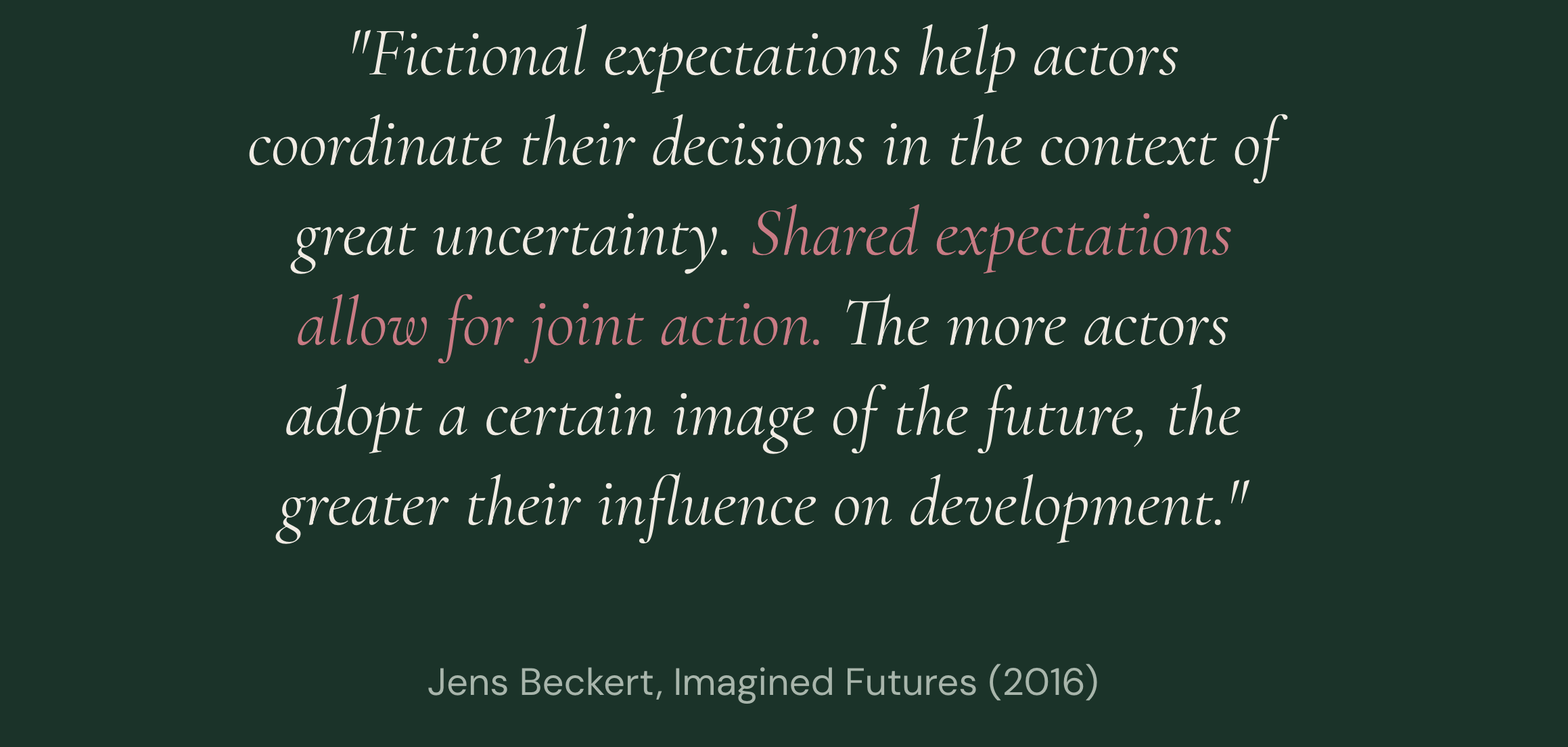
In a future that is open and unpredictable, that is a remarkably uncertain system. How do we deal with it? We tell stories. We try to build shared images. The more people expect the same future, the more they act accordingly, and the more likely that future becomes.
That is why Sam Altman gets on every stage and says, “AGI is coming tomorrow. Maybe even tonight. And if you want to be part of it, give me more money now.” It works so well that his main problem is now explaining where the return on investment will come from. The economic sociologist Jens Beckert makes this case in Imagined Futures. His thesis: we believe we act on rational expectations. In reality, what allows us to act are fictional expectations.
AI as a narrative machine
My thesis: AI is first and foremost a future narrative. There is this line I like: Everything that does not work yet is AI. Once it works, it is software.
Here is what I keep observing: We use an AI tool, see, “Oh, this responds, and it is not bad,” and immediately start extrapolating, “But that means in the future...” And then we only react to the future image we just generated. Not to what the technology actually does here and now. Pay attention when you read articles about AI: How much describes what works today? And how much is extrapolation?
2026 is a particular year for AI. A year ago, the dominant narrative was: the data is running out, and the models are not getting better. That feels very different from where we are now.
How narratives shape technology: Claude Code and OpenClaw. Claude Code has been on the market for about a year; it was originally a developer tool. Then Anthropic released a new model, quality jumped to a different level, and suddenly people spent their Christmas holidays building things they had not thought possible before. Peter Steinberger, an Austrian developer, thought, “I will build my own agent.” He started with a WhatsApp interface, and it turned into OpenClaw, an open-source platform for personal AI agents. Mac Minis sold out everywhere. Why does he build this? Because the narrative of AI as a personal assistant runs deep. Decades of science fiction. Books, films. Jarvis from Iron Man. That is why we keep building these things, and why development keeps heading in that direction.
How narratives reinforce themselves: Matt Shumer. A developer from California, early thirties, has never worked outside of tech. He builds an app with Claude Code one afternoon, steps away, and Claude Code keeps building. His conclusion: it is over. All work. Everywhere. I have been studying the question, “Will AI take our jobs?” since 2012, and I have watched these waves come and go. AlphaGo beats the best Go players, every newspaper writes: within months the machines will take over. Shumer writes “Something Big is Happening” on Twitter (it will always be Twitter to me). A hundred million views. CNN, Forbes. The essay is not particularly good as a piece of writing. But it hits the dominant narrative. Pure confirmation bias: we all have the feeling something big is happening right now. And then someone writes exactly that in a headline, and we nod.
How narratives get misread: the Citrini scenario. Completely different context. People who have been writing reports for Wall Street for years publish a scenario. The author wrote a hundred times: This is not a forecast. This is a scenario. We put the probability at 10 percent. Does not matter. Stock markets drop because of a Substack newsletter. Why? When we see a single scenario, we automatically read it as a prediction we need to take a position on. The only way to understand a scenario as a scenario is when a second scenario stands next to it. That is why futures studies never produce one scenario. Always several.
How narratives move markets: Anthropic and the legal industry. Anthropic releases some plugins for Claude. For contract reviews and NDA screening. No complex software. Just a few Markdown text files. And the stock prices of the major legal information companies crash. Nobody fired their legal department. Nobody seriously tested the tools. Nothing happened. But the dominant narrative (AI takes jobs away) plus the open question (Are we in an AI bubble?) make markets react to every headline. That shows how deeply narratives sit. And how they shape actions in the present, even though nothing has changed about the future yet.
Is this a signal that your industry is being disrupted?
Or is this a narrative translating anxiety into market movements?
We are story animals. We run on stories. And we have a strong tendency to turn everything into a compelling narrative. Man vs. Machine. That is a story that sits deep. The intriguing question is not whether it is true or false. The interesting question is, am I reaching for a story that is much deeper and much older than the current technological development? And it is doing something to me.
That is the diagnosis. The question is, what do we do with it? If narratives are this powerful, can we build our own?
Getting concrete
In critical futures studies, the process always starts with deconstruction (which narratives are in play, and where do they come from?) and then moves to reconstruction: How can we build our own? And the first step is getting concrete.
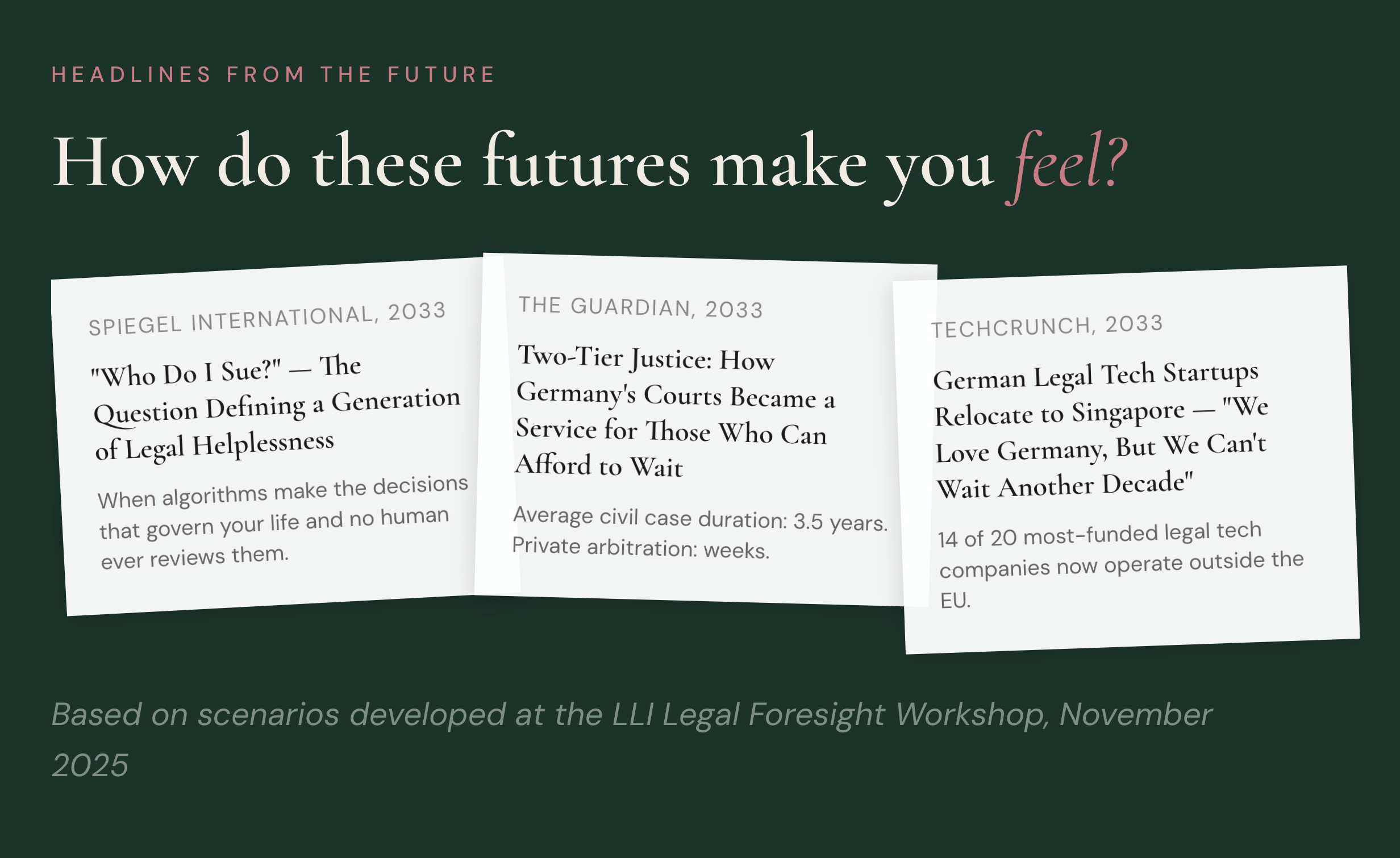
I took the scenarios from the Legal Foresight Workshop in November 2025 and asked, “What happens when we do not stop at abstract scenarios? What might headlines look like in these futures?”
Spiegel International, 2033: “Who Do I Sue? The Question Defining a Generation of Legal Helplessness.”
The Guardian, 2033: “Two-Tier Justice: How Germany’s Courts Became a Service for Those Who Can Afford to Wait.”
TechCrunch, 2033: “German Legal Tech Startups Relocate to Singapore. We love Germany, but we can’t wait another decade.”
What happens when you make things this concrete? It feels immediately different from abstract trends. You notice where something hits a nerve, where emotions surface. And that shows us that something deeper has been triggered: an underlying narrative.
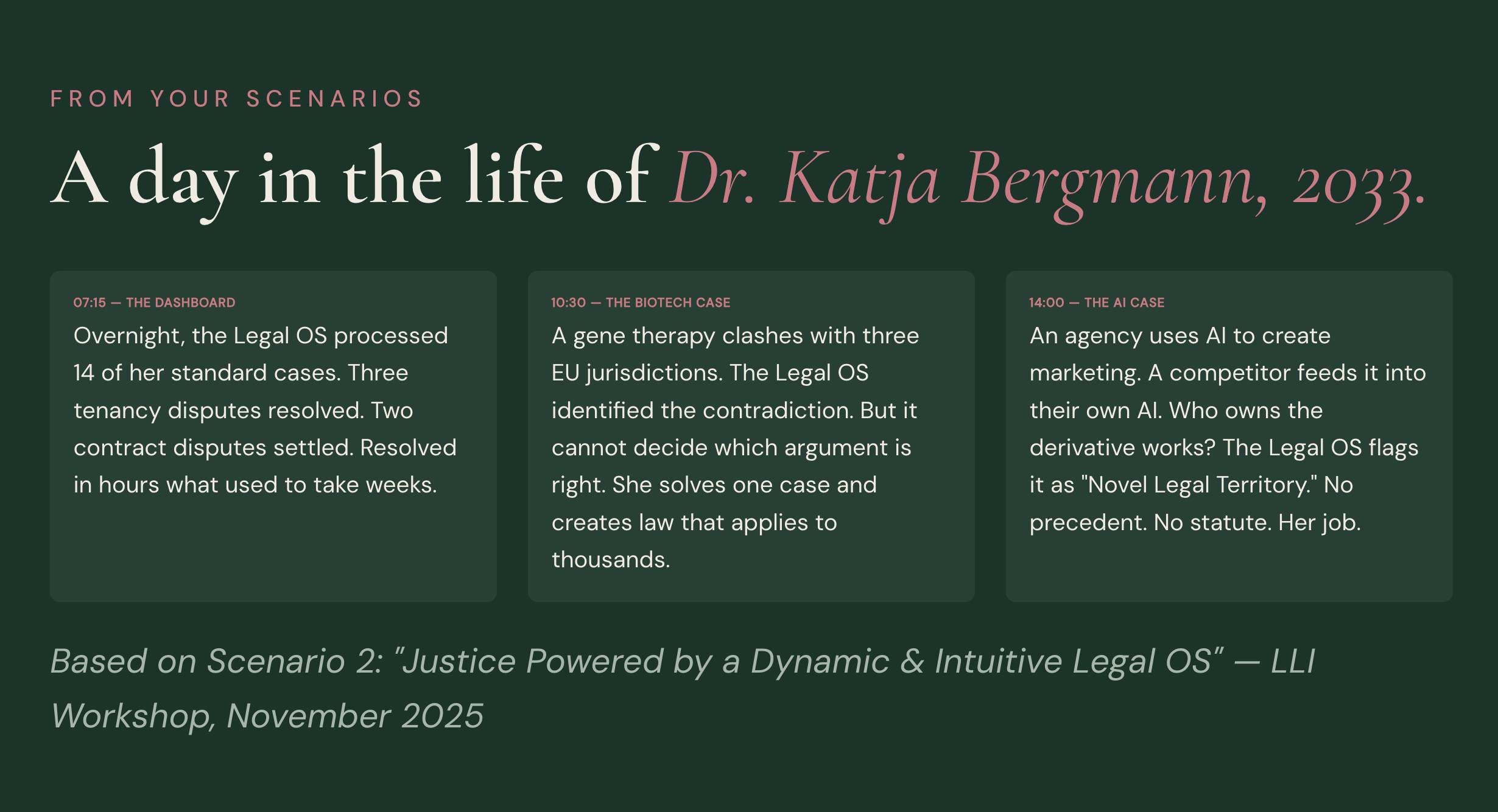
I pushed this further and developed personas for the scenarios. Dr. Katja Bergmann, a lawyer at a Frankfurt firm, in 2033. For each of the four scenarios, I wrote one day in her life.
In Scenario 2, the optimistic one, her morning starts like this:
She opens the BundesJustiz-OS dashboard on her tablet. Overnight, the system processed 14 of her standard cases. Three tenancy disputes: facts recorded, law applied, settlement proposals accepted by both parties within hours. She scrolls through the summaries. Clean. Correct. What used to take weeks, resolved before breakfast. But the case on her desk is different: a Frankfurt biotech startup running gene therapy approvals across three EU jurisdictions whose laws contradict each other. The Legal OS flagged the conflict, produced an 83-page analysis, identified 23 partially applicable precedents. What it cannot do: decide which argument is right. For that, it needs Katja.
That is the difference between abstract trends and concrete scenes. The moment you describe a morning, a case, or a tool interaction, the future stops being a concept and starts being something you can prepare for.
What story do you want to tell?
Here are three recommendations for foresight work in general:
First: Regularly ask yourself which narrative you are currently using. Where does it come from? Who told you? What is behind it? What is their agenda? Is it what you actually want?
Second: Update your mental models. We hear certain things and say, “That is how the world works.” Then the world moves on, but we still carry that old model. Good example: “We all need to become prompt engineers.” That was the future two years ago. Today the machines write their own prompts better than we do. But in many heads, prompt engineering is still “the thing.” Also pay attention to where your signals come from. Is this a signal from Germany, from the US, or from Asia? Our news consumption creates such a jumble that we quickly think, “This is happening everywhere now.” Everyone is drinking matcha lattes. I live in Prenzlauer Berg, Berlin’s poster child for lifestyle trends. Of course everyone there drinks matcha lattes. But that is not the world (and it’s not even true for the Kiez).
Third: Go into detail. Do not stay at the abstract level. Develop scenes, describe the everyday, and look for the uncomfortable. There are things in today’s headlines that you would have said were “never gonna happen” ten years ago.
And then the question I ask all my clients: Scenarios help you orient and explore. However, I urge you to take the next step forward.
What story do you want to tell about the future of your organization?
And what role do you want to play in it?
Are you the one who provides orientation? Who drives change? Who brings the next generation along?
If we do not have our own narrative about the future, we automatically operate inside someone else’s. We should at least decide whether that is what we want.
P.S. If you want to go deeper: I have published research notes on Legal Foresight and The L in STEEPLE in my Digital Garden. The slides are at johanneskleske.com/slides/keynote-futures-of-law.html. A big thank you to Lina Keßler and Kai Jacob for the invitation.
Want me to talk with your organization about this? Write me an email at johannes@kleske.de or just hit reply.
Voices from the workshop
Daniella Domokos on how future foresight methods help sort, prioritize, and orient amid uncertainty, and the responsibility lawyers bear in shaping futures.
Dr. Felix von Held on how foresight has shifted from abstract strategy to practical decision support, and why leaders need to write their own narrative about what comes next.
If you’re in Berlin
From Productivity to Meaning: Working with AI Without Losing Yourself — April 9, 2026. I’m giving a talk on “Cognitive Debt”: the cost of letting machines generate outputs without human engagement in the thinking process. Limited to 60 seats.
New in the Futures Garden
Notes I added or updated in my digital garden this week:
The Forward Deployed Futurist (revised)